
Diversity: Disabled lawyers push for change’ Law Institute of Victoria
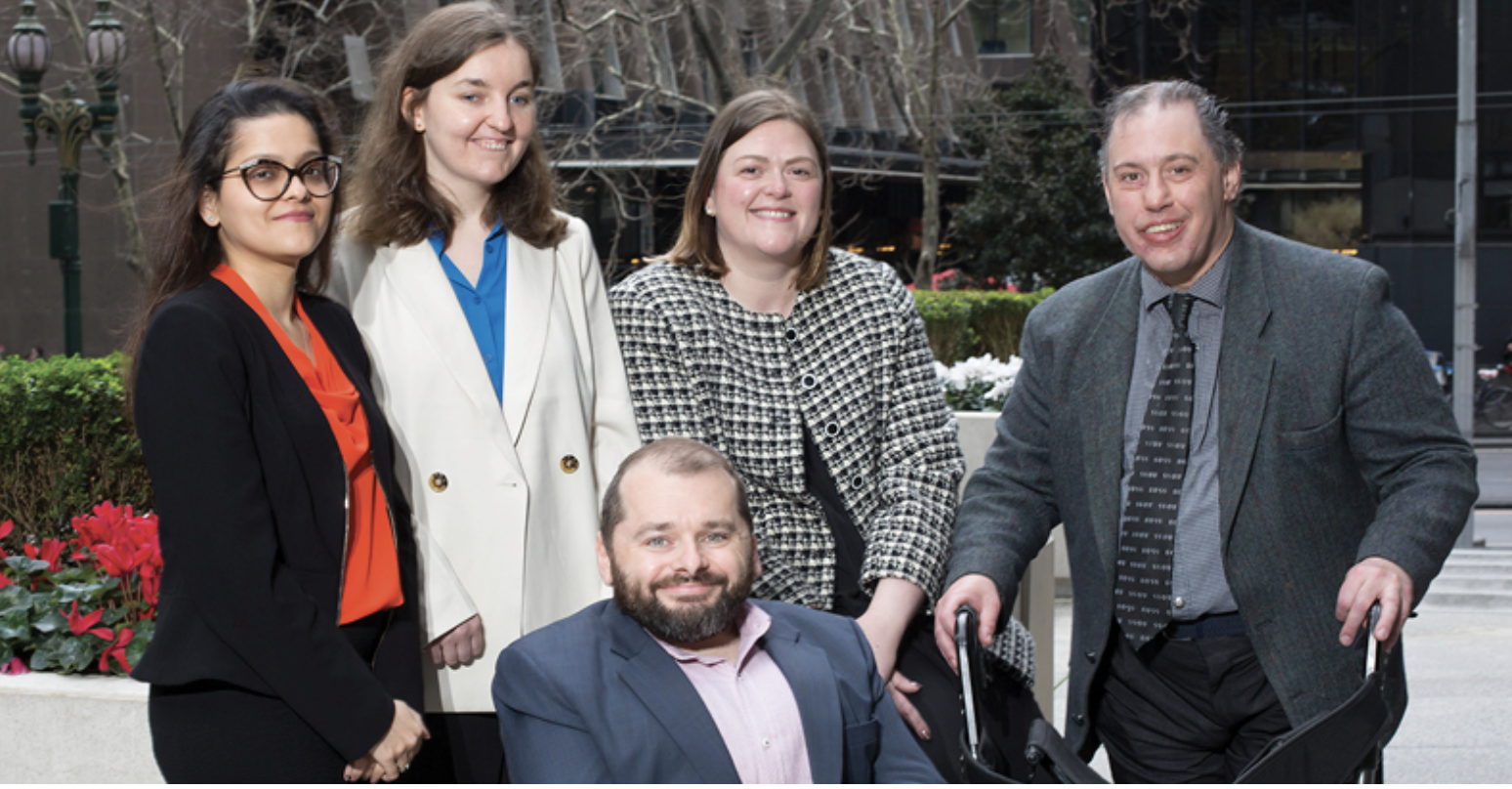
Lawyers Sonia Sawant, Abbey Dalton, Sam Jackson, Rebecca Johnston-Ryan and Emile Barbara
When Russell Kennedy senior associate Rebecca Johnston-Ryan realised she was losing her hearing she was terrified of disclosing the fact to prospective employers.
“I feared that if they knew about my disability I’d be perceived as too much hard work to be able to fit into the workplace. So I either wouldn’t mention I had a disability, or I would say there are just a few little things I need, but don’t worry if you can’t provide them.”
It’s not something she’d do now, 10 years down the track with a successful career across government agencies, including the Coroners Court, Victoria Police, WorkSafe and now private practice.
“Nowadays I will not minimise anything about who I am for any employer. As my confidence in self-identifying as a person with a disability has grown, so has my ability to refuse to accept sub-standard employment conditions that do not help me achieve my very best at work.”
It is estimated that about 20 per cent of Australians have a disability. There are no official figures for the proportion of Victorian lawyers with a disability, but it is likely to be similar to NSW data that shows about 6 per cent of legal practitioners identify as having a disability.
Among them is Emile Barbara, who has cerebral palsy. He says the biggest obstacle he faced in becoming and practising as a criminal lawyer was the scepticism of others. “That just made me more determined to prove them wrong,” he says. Inspired by his great great grandfather Vincent Micallef, who was a Supreme Court chief justice in Malta, and encouraged by his mother, a registered migration agent, he studied criminal justice administration and then completed a Juris Doctor at RMIT.
After being mentored by Nicholas Papas KC and then solicitor Ian Robinson, he is now a sole practitioner with his firm Criminal Lawyers Victoria. Mr Barbara says he has more than 200 criminal law clients on his books and specialises in assisting people on remand who are otherwise unrepresented. “I’ve always been interested in criminal law. It’s intriguing and fulfilling and intellectually challenging. I wouldn’t give it up for anything.”
He travels to courts and remand centres across the city by taxi. “I’m completely mobile and self-sufficient.” The only support he says he would appreciate is a legal assistant to help him with the day-to-day running of his practice. “I’ve got a lot of files, which you would find in any busy law practice.”
Sparke Helmore workplace relations lawyer Sam Jackson, who has Bruck syndrome and gets around in a wheelchair, says he has encountered less discrimination in the workplace than in the supermarket. “Occasionally I’ll roll into a boardroom, and you might see a flicker of surprise in the eyes of people who weren’t expecting someone in a wheelchair – but beyond that it’s just never been an issue.”
His only accommodation at Sparke Helmore was to have his desk lowered. “I’m pretty short”, he says. But if he had the opportunity to start over, he says he might have been more upfront about other things that would make life easier, such as a more accessible kitchen. “It might seem a small thing, but these are things that can be really exclusionary for people like me.”
Minimising disability is a coping mechanism that people with disabilities have developed to fit in, or to avoid feeling like you’re imposing, Mr Jackson says. “It’s the make do mentality. Whether it’s wanting to fit in or going under the radar so you don’t miss out on the job offer because the company feels there’s too much to do.”
The social model of disability is that people are disabled by their environment, Mr Jackson says, not by their actual impairment. “So if these small, targeted adjustments can be made in a profession where our brains are our assets, we don’t need to be physically able.”
As someone with an obvious disability, Victorian Government Solicitor’s Office (VGSO) solicitor and co-founder of the Disabled Australian Lawyers Association (DALA) Abbey Dalton has had no choice but to disclose her blindness. “I’ve had to be fairly upfront about my disability to ensure I can most effectively work with my team,” she says. “For the purposes of working with me, my disability means that I can’t read hardcopy or image-based documents. I need something in text-based electronic format.”
Technology has helped her to access documents and other materials. She uses a text-to-speech program that converts on-screen material to speech, as well as a braille display that converts on-screen text into braille for when she needs more intricate attention to detail.
At VGSO she is in a supportive workplace where her colleagues are keen to understand how they can best work together including how to best accommodate her disability. But she says many disabled lawyers experience challenges in negotiating workplace adjustments and the court system.
That can be especially problematic for the approximately 90 per cent of DALA’s members who have disabilities that are not immediately visible or apparent. These disabilities might include hearing impairments, cognitive or psychosocial disabilities, chronic pain or fatigue conditions, or neurodivergence such as autism or attention deficit hyperactivity disorder (ADHD). “You shouldn’t presume you don’t have any disabled employees in your workplace because you almost definitely do,” Ms Dalton says.
That invisibility has been an issue for VLA deputy managing lawyer and member of the DALA leadership team Sonia Sawant. She became aware that her hearing was becoming impaired after she had been working at VLA for a few years. “I was constantly having to ask people to repeat themselves.”
Even after her hearing impairment was diagnosed and she was issued hearing aids, it took months before she became comfortable wearing them. “It’s a very different kind of sound and you can get a lot of feedback and the wrong sounds get amplified.” The sounds of rustling paper as a prosecutor or magistrate thumbed through the briefs would interfere with the sound of the speech.
“I had a lot of appointments with my audiologist to tweak the sounds, and my manager really helped by setting up a mock courtroom for me to practise and to try to improve the sound on the app that goes with the hearing aids.”
Because her disability is not obvious and she is of Indian heritage, people sometimes assume she doesn’t understand English or their accent, when the problem is that they are not speaking clearly. “It’s always a conversation that you have to bring up. And while most people are receptive when I tell them this is what I’m struggling with, it can be frustrating when you have to keep reminding people.”
Ms Dalton says it’s always worth being upfront about your disability. “People are fairly open to learning and broadening their understanding of how they can best work with disabled people. Of course, some people are going to have misconceptions about disabled people. But that’s a good indicator that they are probably not the kind of people I want to be working with in an organisation.”
For many young lawyers with a disability, just getting through an interview for their first job is the biggest obstacle. Ms Johnston-Ryan urges them not to fear disclosing their disability in an interview, and to regard it instead as a chance to question the workplace about its disability and inclusivity plans.
“I’m now unwilling to put up with workplaces that don’t provide what it is I need. I want to know if it’s a workplace that’s going to treat me well in terms of taking care of me and providing for my adjustments and if they’re not I have no interest in working there.”
DALA says it has been advocating with firms to better engage with disabled employees. Firms like Russell Kennedy, DLA Piper and Herbert Smith Freehills run clerkship programs specific to lawyers with disabilities.
Rather than regarding recruiting disabled lawyers as a “tick-a-box” diversity exercise, firms should recognise the value they bring to a workplace as problem solvers, Ms Dalton adds. “Disabled people are operating in an environment that wasn’t built with them in mind. So they’re always having to engage in problem solving and communication, which are two really crucial skills that employers are looking for.”
The fact that many lawyers with a disability have had to face many more barriers than the average law student to even become a qualified and practising solicitor shows they have been able to overcome significant challenges, and that they are not shy of hard work, Ms Johnston-Ryan says.
“This is a person with a track record of being told they can’t do something, and taking great pride in going ahead and achieving that goal despite all of the challenges and barriers to success they may have faced.” ■
How legal workplaces are accommodating disabled practitioners
Law firms and legal workplaces are gradually recognising the need to accommodate their disabled practitioners. An increasing number make reference to programs and policies to support practitioners with a disability within their wider diversity and inclusion ambit.
DLA Piper, for instance, is working “to create a culture that empowers people with a disability to be open about their needs, without fear of judgment or bias, and receive the support and adjustments they need at work”.
Norton Rose Fulbright says it wants to remove barriers and challenges faced by people living with disability. “We have a workplace adjustments policy to ensure people with disability are able to perform at their best both at interview and as employees.”
Herbert Smith Freehills is committed to creating a culture of inclusion across the firm, including for those who experience disability. “Our global Ability network supports those with disabilities, long-term health conditions or who care for someone who does”, says director of culture and inclusion Danielle Kelly.
“Through the network we focus on building disability confidence throughout the firm, encouraging a better understanding of disability and influencing policies and practices in becoming an employer of choice for those with a disability,” Ms Kelly says.
But while many practitioners have achieved the adjustments they require to work efficiently in their day-to-day legal workplace, negotiating the court system raises a new level of potential obstacles.
DALA is currently looking at ways courts and judicial officers can be made more aware of accommodations that might be required by practitioners. This includes wheelchair accessible courtrooms, more flexible courtroom timetabling and training for judicial officers to work with practitioners who have a disability.
The Supreme Court’s heritage design challenges disability access. Some courtrooms have been acoustically upgraded to reduce echoes, and alternative courtroom options include e-courts offering remote access, high quality audio access for hearing aid wearers, and larger screens for vision impaired. Lawyers needing support are urged to contact the Court registry or relevant judicial chambers.
Further along is the County Court where judge and co-chair of the Court’s diversity and community relations committee Judge My Anh Tran says the Court is actively looking at ways of enhancing equitable access to the Court, both as a workplace and as a site of justice.
Judge Tran recently contacted DALA to discuss the accessibility requirements of disabled practitioners. “There’s a lot of energy and enthusiasm in the Court to improve the experience of disabled parties, witnesses, practitioners and staff coming to the Court. We want this to be actioned in meaningful ways, and that means getting the voice of people who have that lived experience of disability who use the Court.”
Judge Tran wants practitioners to feel comfortable to communicate their specific requirements. “Everybody needs accommodations tailored to their particular needs, so we need to make sure that we’re welcoming and approachable in that respect so people feel they can say, for instance, they need to have a break at 11am, or need the volume to be turned up so they can hear properly.”
One option suggested by DALA is for courts to include in their intake form a field that allows practitioners to indicate any adjustments they might require, as is already done in South Australia’s CourtSA portal.
That kind of IT upgrade may take some time, Judge Tran points out, but in the meantime she urges disabled lawyers to contact the diversity committee via the website with requests for accommodations.
The approach of some judicial officers may also need adjusting, Rebecca Johnston-Ryan points out. “Seared in my memory for life is a particularly awful courtroom interaction with a former magistrate who was unwilling to make any adjustments for my disability and was absolutely scathing in voicing their views on whether I should be in a courtroom at all given my disability.”
But they are exceptions rather than the rule, she adds. “I’ve had some fantastic magistrates who have been really supportive. That makes such a difference in helping you get on with the job you’re there to do.”